
 EN
EN
 ar
ar bg
bg hr
hr cs
cs da
da nl
nl fi
fi fr
fr de
de el
el hi
hi it
it ko
ko no
no pl
pl pt
pt ro
ro ru
ru es
es sv
sv tl
tl iw
iw id
id lv
lv lt
lt sr
sr sk
sk sl
sl uk
uk vi
vi et
et hu
hu th
th tr
tr fa
fa ms
ms hy
hy ka
ka ur
ur bn
bn mn
mn ta
ta kk
kk uz
uz ku
ku
Solid vs Hollow Load Cell: A Comprehensive Guide to Engineering Selection (Force Paths & Typical Applications & Certification Requirements)
The choice between a solid load cell vs hollow load cell is a genuine engineering decision. It is not a battle over product features. The fundamental difference lies in how force is introduced to the sensor. This load path determines where each type performs reliably and where it will inevitably fail. This article serves as a decision tool. It grounds the comparison in engineering logic rather than brand preference. We will start with what each sensor actually is. The words "solid" and "hollow" describe shape, but they do not describe function.
1. What is a solid load cell — and how does it measure force?
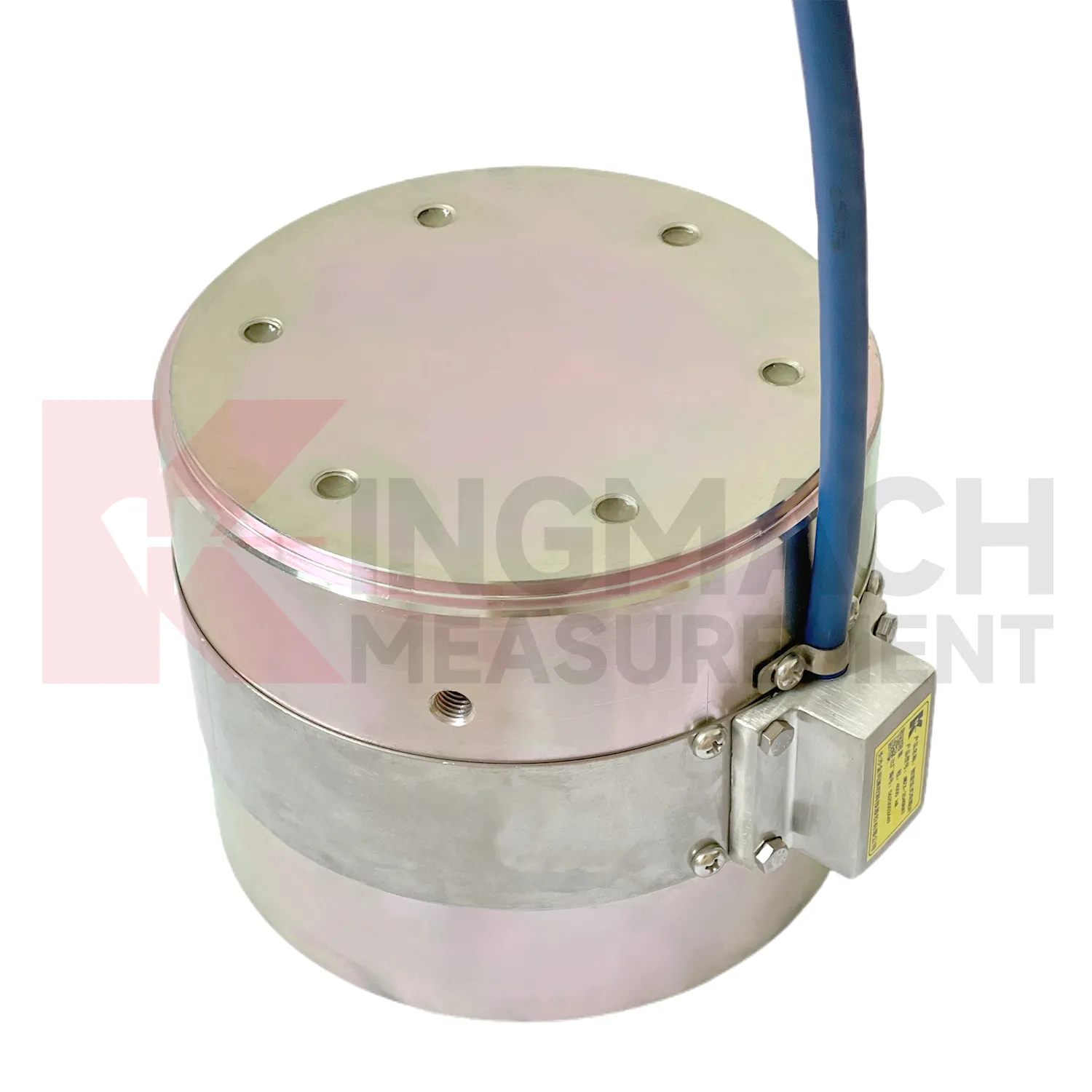
Engineers already know what a cylinder looks like. What they truly need to understand is the load path through a solid body. A solid load cell features a core architecture based on a solid-body cylindrical compression element. The elastic steel body деforms uniformly under an axial compressive load. Embedded vibrating wire strings sit inside the body. These strings detect the micro-strain as a distinct frequency change.
The load path logic is straightforward. The load enters the top bearing surface. It travels through the full cross-section of the elastic element. Finally, it exits through the bottom bearing surface. The cell itself becomes a structural insert. It carries the physical load.
The multi-string design averages readings across multiple measurement points inside the body. Lower capacity ranges utilize a 3-string design. Higher capacity ranges require a 6-string design. This multi-string averaging gives the Kingmach JMZX-34XX/35XX/36XXHAT series its 0.5% FS precision. It maintains this precision across a massive 1,000–10,000 kN range, despite demanding operating environments.
The device features a smart HAT chip onboard. This intelligent chip stores the calibration coefficient natively. It auto-corrects for temperature via a built-in thermistor. It also saves up to 600 measurement records. The sensor remembers its own history even without a connected data logger.
The operating range spans from −30°C to +80°C. Furthermore, the solid cell boasts an overload tolerance of up to 300–400% of its rated capacity before catastrophic failure. This provides a highly meaningful safety margin. Sudden accidental overload is a very real risk in pile testing and bridge bearing applications.
[View Complete Specifications for the Kingmach JMZX-35XXHAT Solid Load Cell]
2. What is a hollow load cell — and what makes it structurally different?
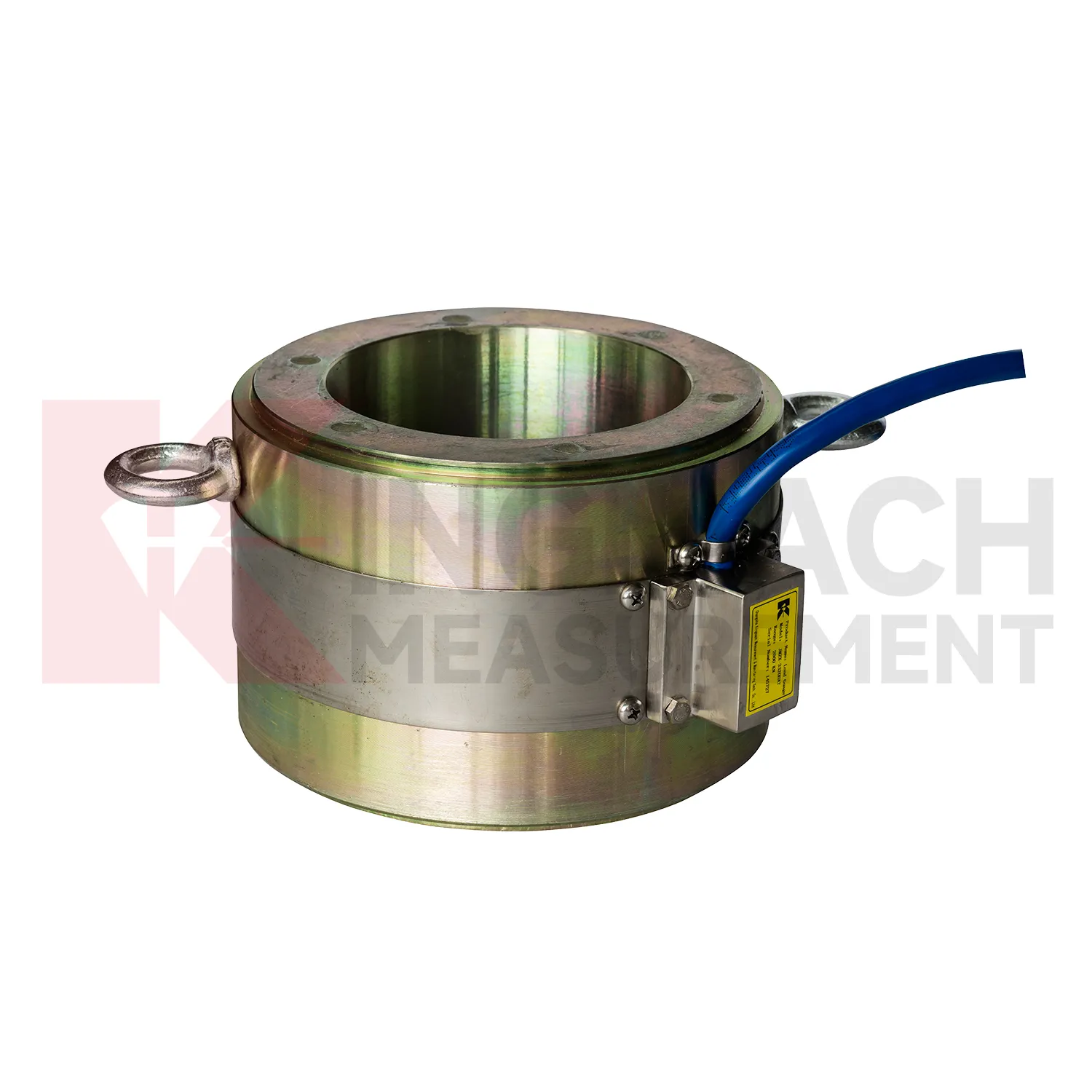
A hollow load cell is also known as an annular load cell. The core architecture relies on an annular (ring-shaped) body with a central bore. The structural member passes through the center of the cell. This member could be an anchor rod, a cable, or a bolt. The load transfers from the structural member's nut directly to the cell's annular face. The load does not enter the bore wall itself.
The load path logic differs entirely from a solid cell. The load enters via the annular bearing surface. The ring body compresses uniformly around its circumference. Multiple vibrating wire strings sit arranged around the ring. These strings average the compression signal. This multi-chord design powerfully compensates for minor eccentric loading. A single-string design simply cannot handle uneven loads.
This multi-chord design utilizes three chords at lower ranges. It progresses to six chords for the 4,000–8,000 kN range. This specific architecture enables the JMZX-3XXXHAT Hollow Load Cell to be installed on a live anchor rod without disassembly. The rod simply threads through. The nut bears on the cell face. Monitoring begins immediately.
The hollow cell features a design service life of 50 years. The elastic steel body undergoes multi-stage stability treatment before it ever leaves the factory. The internal vibrating wires feature ultra-high-strength steel. Technicians anchor these wires using international standard welding technology. These are not basic specification claims. They are vital design decisions that matter deeply in 20-year dam safety programs.
This cell carries dual certification to GB/T 13606-2007 and DL/T 269-2022. The second standard is specific to hydraulic and power engineering. This makes it the only correct choice for dam and hydropower anchor monitoring.
[View Technical Specifications for the JMZX-3XXXHAT Hollow Load Cell]
3. Specifications Side by Side: What the Numbers Actually Mean
| Attribute | Solid Load Cell (JMZX-35XXHAT) | Hollow Load Cell (JMZX-3XXXHAT) | What it Means in Practice |
|---|---|---|---|
| Capacity Range | 1,000–10,000 kN | 500–8,000 kN (Custom available) | The hollow cell’s lower 500 kN entry point suits smaller anchor rods. A solid cell would be over-specified here. For ultra-high-capacity pile foundation testing applications exceeding 8,000 kN, Kingmach can provide customized JMZX-36XXHAT solid load cell solutions. Feel free to contact our technical team for more information. |
| Resolution | 0.1 kN (All models) | 0.1–1 kN (Varies by model) | The solid cell’s consistent 0.1 kN resolution aids precision pile testing. The hollow cell's 1 kN resolution is acceptable because monitored loads are proportionally large. |
| Memory Capacity | 600 records | 800 records | The hollow cell’s larger onboard storage reflects its longer-duration deployment profile for decades-long monitoring. |
| Certifications | GB/T 13606-2007 | GB/T 13606-2007 & DL/T 269-2022 | The additional hydraulic engineering standard (DL/T 269-2022) ensures strict project compliance in dam environments. |
| Design Service Life | Not specified (Application dependent) | 50 years | The hollow cell is engineered for permanent monitoring. The solid cell is commonly used in temporary testing phases. |
These numbers offer excellent guidance. However, the more revealing question is where each type truly belongs in a real project.
4. Where Solid Load Cells Perform Best — and Why
This section explains why the solid cell's specific load path makes it the correct choice. We are looking at reasoning, not just cataloguing features.
Pile load testing: The solid load cell for pile testing is a perfect match. The solid cell sits directly between the pile head and the loading jack. The full test load passes straight through the cell body. The solid's ability to carry the load structurally is absolutely essential here. Its massive capacity up to 10,000 kN covers the largest diameter bored piles in bridge foundations.
Bridge pier bearing seat monitoring: The cell acts as a structural insert within the bearing stack. It must carry immense design loads indefinitely while actively measuring them. The solid body's compression geometry handles this perfectly. The Kingmach solid load cells reference dimensions correspond seamlessly to standard bearing plate dimensions in bridge design codes.
Hydraulic jack force measurement: Post-tensioning operations require strict oversight. The solid cell sits under the jack. It measures the applied force in real time. This verifies that the design pre-stress is actually achieved on-site. Engineers cannot simply rely on jack pressure calculations.
Temporary works load monitoring: Construction teams monitor formwork, falsework, and shoring. The monitoring program ends when the structure finishes. The team removes the instrumentation. The solid cell's high overload tolerance makes it a robust, reusable choice for rough construction-phase work.
Why it fails on through-rod applications: A solid cell has no central bore. It cannot sleeve onto a rod or cable. Engineers cannot adapt it easily. Creating custom end fittings introduces eccentric loading immediately. This directly compromises measurement accuracy and ruins the data.
[See Real-World Applications of Kingmach Products in Specific Project Types]
5. Where Hollow Load Cells Perform Best — and Why
The hollow cell is not simply a modified solid cell. It is a fundamentally different instrument. It is optimized for an entirely different loading geometry.
Anchor cable and pre-stressed tendon monitoring: Hollow load cell applications shine here. The rod or cable threads smoothly through the central bore. The nut or anchor plate bears flat on the annular face. The cell measures the actual pre-stress force in the tendon. It does not measure the jack input. It measures the real force in the structural member after lock-off and over time.
Rock bolt and ground anchor monitoring: Tunnels, slopes, and retaining walls rely on rock bolts. The hollow cell sits at the bolt head during initial installation. It remains there for the life of the structure. Its 50-year design life matches the long-term monitoring program duration. Smaller diameter models correspond accurately to standard rock bolt head dimensions.
Dam and hydropower anchor monitoring: The DL/T 269-2022 certification is strictly mandatory for Chinese hydraulic engineering standards. It is a rigid compliance requirement. The hollow cell's dual certification covers this legal necessity. The solid cell does not hold this specific hydraulic standard.
Bridge stay cable and hanger monitoring: Retrofit monitoring programs often target existing bridges. The annular form factor allows easy installation on existing cables. Technicians only need access to the anchor end. The installation requires no cutting of the structural element. This is often the deciding factor for procurement engineers.
Why it fails in simple bearing applications: The hollow cell features an annular geometry. This shape naturally concentrates load onto the narrow ring bearing face. Placing it inside a flat bearing stack without a correctly sized through-rod introduces a non-uniform stress field. The sensor reads this stress correctly, but the reading does not represent the true bearing load.
[See Real-World Applications of Kingmach Products in Specific Project Types]
6. Installation Logic: What Each Type Demands of the Site Team
Installation requirements ultimately dictate where projects succeed or fail. Both vibrating wire load cell types demand high precision from the site team.
Solid cell installation requirements: Flat, parallel bearing surfaces are absolutely non-negotiable. A mere 1mm surface irregularity across a 200mm diameter cell face ruins the data. It introduces massive, measurable eccentric loading. Teams must use spherical seating washers as standard practice. Technicians must verify proper alignment with the load axis before applying the very first load.
Hollow cell installation requirements: Bore-to-rod clearance must match the specified tolerance exactly. The central rod must never contact the inner bore wall under load. Technicians perform the installation at the anchor head before the nut is tensioned. Re-installation after tensioning is practically impossible. The team would have to fully de-stress the entire anchor to fix a mistake.
Signal continuity planning: Both load cell types utilize the smart HAT architecture. They provide excellent long-distance digital output. However, technicians must plan the cable routing from the sensor to the data logger during installation. They cannot retrofit cables easily. Buried and underwater cable runs require heavy armored cable. They also demand waterproof junction boxes strictly rated for the exact installation depth.
The shared risk: Both cell types remain highly vulnerable to early errors. Mistakes made at installation cannot be corrected later without severe physical intervention. Getting the precise installation right the first time is not over-engineering. It is the only option.
7. Decision Checklist: Five Questions That Lead to the Right Choice
Engineers face tight deadlines. Use this concise decision tool to guide your procurement strategy.
Question 1 — Is there a structural member (rod, cable, bolt) that must pass through the sensor?
Yes: Choose hollow.
No: Choose solid.
Question 2 — Will the sensor carry structural load entirely, or only sense it?
Must carry full load internally: Choose solid.
Sense only (force transferred via bearing face): Choose either type, strictly depending on Question 1.
Question 3 — Is this a temporary test or a permanent monitoring installation?
Temporary test / construction phase: Choose solid.
Permanent / long-term SHM program: Choose hollow (features a 50-year design life).
Question 4 — Does the project fall under hydraulic engineering or power sector standards?
Yes: Choose hollow (DL/T 269-2022 certified).
No: Either type satisfies the general GB/T 13606-2007 standard.
Question 5 — What is the required monitoring capacity?
Below 500 kN: Choose hollow (entry models available).
10,000 kN or above: Choose solid (hollow normally tops out at 8,000 kN standard, though custom options exist).
Closing note on the checklist: If two or more questions point your team in opposite directions, pause immediately. Your application requires a specialist review. Kingmach provides custom configurations to handle complex hybrid requirements.
The Geometry of the Application Decides the Geometry of the Sensor
Solid load cells and hollow load cells are never competing products at different price points. They are fundamentally complementary instruments designed for entirely different load paths. The project's unique geometry always determines which sensor is correct.
Many large-scale projects require both types simultaneously at different monitoring points. A complex bridge program might use solid cells safely at the bearing seats, while simultaneously deploying hollow cells at the stay cable anchors.
Still unsure about the right solution for your project? Fill out the technical consultation form below, and Kingmach engineers will provide customized selection recommendations within 24 hours. [View Solid Load Cell Product Page] · [View Hollow Load Cell Product Page] · [Download Full Technical Datasheet (PDF)]
FAQs
1. What is the main difference between a solid and hollow load cell?
A solid load cell has a continuous cylindrical body designed to carry full structural loads through its core. A hollow load cell features an annular ring design with a central bore, allowing structural members like anchor rods to pass directly through the center.
2. Can I use a solid load cell for anchor cable monitoring?
No. A solid cell lacks a central bore. You cannot thread an anchor cable through it. Attempting to adapt it with custom end fittings introduces severe eccentric loading and corrupts the data.
3. Why do hollow load cells have longer design life?
Manufacturers engineer hollow cells primarily for permanent, decades-long structural health monitoring (SHM) programs. The 50-year design life reflects multi-stage stability treatments and ultra-high-strength steel optimized for long-term deployments.
4. Does a hollow load cell measure the jack pressure or the true tendon force?
It measures the true tendon force. The hollow cell sits under the anchor nut. It actively measures the actual load remaining in the structural member after lock-off and long-term relaxation.
5. Do I need special certification for dam monitoring?
Yes. In regions following Chinese hydraulic standards, load cells deployed in dam and hydropower applications must hold DL/T 269-2022 certification. Solid cells typically do not carry this certification.
6. What data acquisition systems are required for solid and hollow load cells respectively?
Kingmach provides a full range of vibrating wire data loggers compatible with the JMZX-HAT series, supporting RS485, SDI-12, and analog output interfaces. These systems can be integrated with mainstream structural health monitoring platforms.
7. Under the DL/T 269-2022 standard, what is the installation and acceptance procedure for hollow load cells?
Before installation, the rod-to-hole clearance must be verified to ensure it meets the design specifications. After installation, initial reading records and tension-locking verification must be completed. For detailed procedures, it is recommended to refer to the appendix of DL/T 269-2022 or contact Kingmach technical support.
8. Compared with strain gauges and fiber Bragg grating sensors, what irreplaceable advantages do load cells offer?
Load cells directly measure internal structural stress without the need for indirect calculations. Vibrating wire load cells offer strong anti-interference capability, making them highly suitable for harsh engineering environments such as humid, low-temperature, and underground conditions, while also supporting long-distance signal transmission. In contrast, strain gauges are more susceptible to temperature drift and cable length effects, while fiber Bragg grating sensors are relatively expensive and involve more complex installation procedures.
Related Reading: Load Cell Troubleshooting Guide: 6 Common Issues and Field-Proven